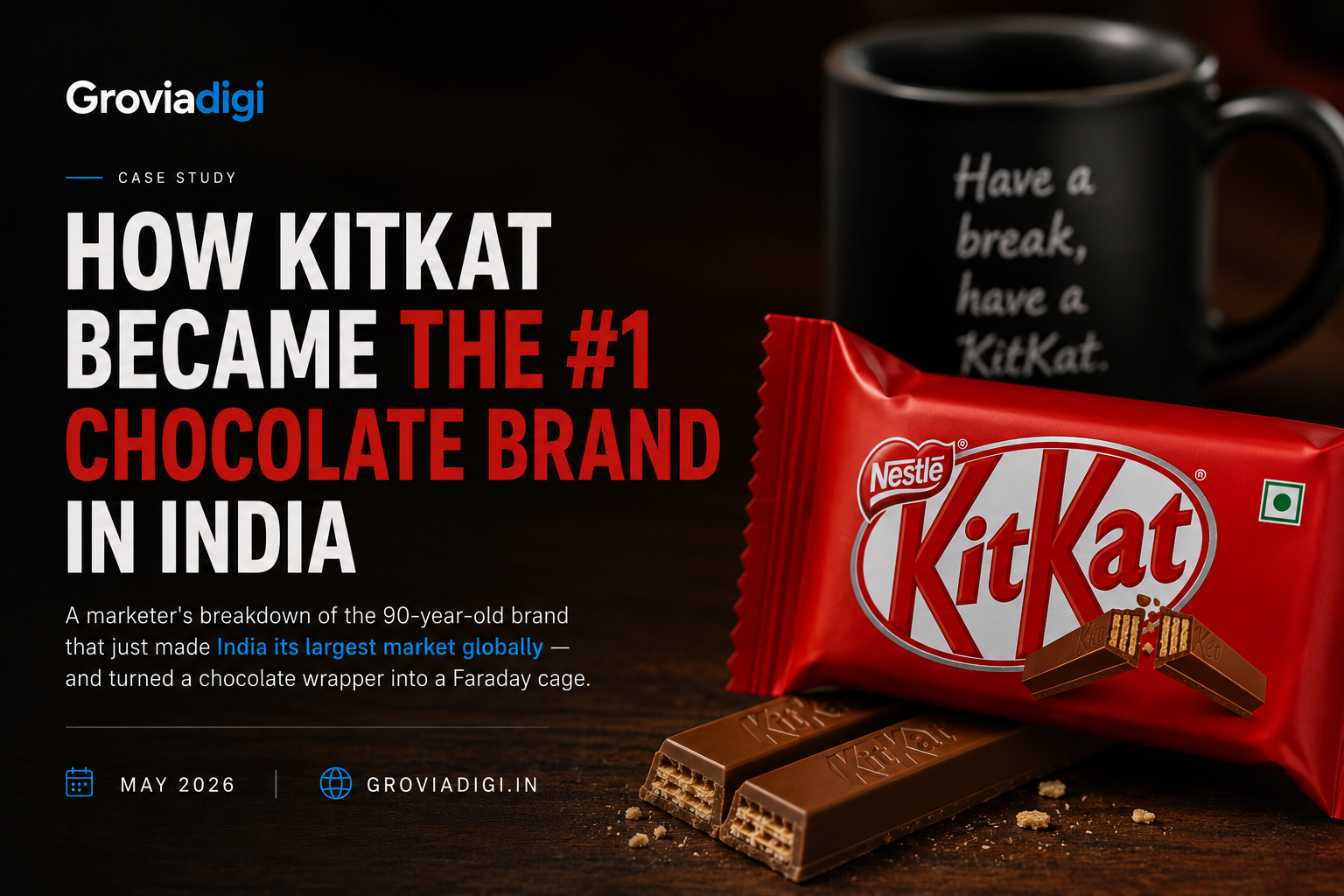
How KitKat Became the #1 Chocolate Brand in India: A Marketing Case Study (2026)
A marketer's breakdown of the 90-year-old brand that just made India its largest market globally — and turned a chocolate wrapper into a Faraday cage.
Abhuday Tripathi
Founder, Grovia Digi · May 2026
The two news stories that prompted this case study
Two pieces of news landed in the last few weeks that, taken together, are worth a full marketing case study for any brand team, founder, or digital marketer working in India today.
First, Nestlé India officially confirmed that India has overtaken Japan, Brazil, and every other country to become the largest market for KitKat globally. A decade ago, India was ranked #10. Today it sits at #1, ahead of 85 other countries Nestlé sells the bar in. The full announcement was covered by Outlook Business and Storyboard18.
Second, in April 2026, KitKat Panama and Ogilvy Colombia released "Break Mode" — a chocolate wrapper engineered with metallic, conductive layers that turns the used packaging into a Faraday cage for your phone. Slide your phone inside, and it cuts off all calls, internet, Bluetooth, and GPS. The campaign was covered by Dezeen, Fast Company, Digital Trends, and Mediabrief.
A 90-year-old chocolate bar. One of the most commoditised product categories on the planet. And it's outmaneuvering brands a fraction of its age.
Here at GroviaDigi, we work with founders and marketing teams every week, and this is the case study we keep coming back to. So we pulled the entire playbook apart. Below is what we found, the marketing principles behind it, and what every Indian brand can take from it.
Principle 1: Sell the occasion, not the product
In 1957, JWT London copywriter Donald Gilles wrote five words that would carry the brand for the next 68 years: "Have a break, have a KitKat."
The full slogan history and commercial breakdown is documented by Vaia.
Read that line again. There is nothing in it about chocolate. Nothing about taste, ingredients, quality, or price.
What Gilles did, in modern marketing language, was claim a Category Entry Point. He didn't position KitKat against other chocolates. He positioned it against stress, work, and the clock — specifically, the 11 a.m. tea break for British factory workers.
This is the move every marketer working on a commodity product should screenshot.
The minute your positioning becomes "we taste better / we cost less / we're premium," you're locked in a feature war. Margins compress. CAC inflates. You die in a price war you didn't pick.
The minute your positioning becomes "we own the 4 p.m. slump" or "we own the post-gym 20 minutes" or "we own the Sunday-evening anxiety" — suddenly the entire moment becomes your distribution. Every coffee break, every exam, every "I need 5 minutes" becomes a buying trigger you don't pay media to activate.
Principle 2: Distinctiveness beats differentiation
Byron Sharp's argument in How Brands Grow, which has become more true every year: brands don't grow by being different. They grow by being recognisable.
Look at KitKat's distinctive brand assets through this lens:
- The red wrapper
- The four-finger snap
- The "Have a break" line
- The break itself as a ritual
None of these are about how the chocolate tastes. They're memory structures. They make the brand effortless to recall the instant a consumer enters a buying moment. That's why a tired guy at a kirana counter in Ajmer at 4 p.m. doesn't have to think — his hand goes to the red wrapper.
Most Indian D2C brands we see at GroviaDigi are doing the opposite. Re-skinning packaging every six months. Chasing a new tagline every campaign cycle. Borrowing the visual language of whatever's trending. They're optimising for novelty when they should be optimising for memory.
KitKat in 2026 looks recognisably like KitKat in 1986. That's not laziness. That's discipline.
Principle 3: Localisation isn't translation. It's reconstruction.
KitKat entered Japan in 1973. By 2014, it had overtaken Meiji to become the #1 selling confectionery in the entire country — beating a deeply entrenched local brand on its home turf. The full history is documented in Wikipedia's Kit Kats in Japan article.
What Nestlé Japan did not do: translate "Have a break" into Japanese.
What they actually did:
Move 1: They turned a phonetic coincidence into a 20-year campaign.
"Kit Kat" sounds like the Japanese phrase Kitto Katsu— roughly meaning "you will surely win." Nestlé built a multi-decade exam-season ritual around this, positioning KitKat as a good-luck gift for students writing university entrance exams. They partnered with Japan Post to sell exam-day KitKats through 20,000 post offices. The campaign won a Cannes Lions Media Grand Prix in 2010.
Move 2: 400+ regional and seasonal flavors.
Matcha, wasabi, sake, soy sauce, purple sweet potato, cherry blossom. Not because each flavor was great — because each one became a collectible souvenir that leveraged Japan's omiyage (gift-giving) culture. The full market-entry strategy is broken down by btrax and Marketing Mind.
Move 3: They stopped being an "English chocolate."
A tourist in Tokyo today thinks matcha KitKat is a Japanese invention. The cultural takeover is so complete that the brand essentially became Japanese-coded for the rest of the world. Medium / IGNITION INT has a strong long-form breakdown of how this transformation happened.
Nestlé Japan's executive Olivier Jakubowicz said it plainly in a recent interview with Bakery and Snacks: any global brand serious about Japan has to Japanise itself. Same product in a local flavor is not enough. You need to localise positioning, route to market, and innovation.
Principle 4: Occasion expansion beats penetration optimisation
Nestlé India MD Manish Tiwary confirmed that KitKat is now the fastest-growing chocolate brand in India, with 3,950 million fingers sold in FY25 — roughly double its previous market share.
The growth did not come from making the chocolate better. It came from entering occasions where KitKat previously did not exist:
- Gifting — KitKat Celebreak
- Nibbling — KitKat Pops
- Premium indulgence — KitKat Delights (Salted Caramel, Hazelnut)
- Mainstream innovation — KitKat DUO, KitKat Lemon and Lime
This is the Japan playbook, re-engineered for India. Instead of 400 flavors, occupy 4–5 new consumption occasions the brand was previously invisible in.
KitKat stopped being just an impulse buy at a kirana counter. It became a gift. A nibble. A premium indulgence. A flavor experiment.
The "Break Mode" wrapper: Why this is the smartest brand marketing of 2026
In April 2026, KitKat × Ogilvy Colombia released "Break Mode" — a special-edition KitKat wrapper engineered with metallic, conductive layers that turn the packaging into a Faraday cage. Eat the bar, drop your phone inside the wrapper, and your phone goes dark.
The strategic genius here isn't the engineering. It's:
1. The brand truth got physically manifested.
For 68 years, the brand has told you to "have a break." This campaign literally manufactures the break. The brand isn't saying the value — it's delivering it.
2. The product is the ad.
A limited run of physical wrappers got more international press in 10 days than most ₹5 Cr media plans buy. That is the earned media economics every CMO should be benchmarking against.
3. It's PR-able, not advertisable.
No one shares a 30-second hero film. Everyone shares a chocolate wrapper that jails your phone.
What every Indian marketer should take from this case study
Four principles every marketer should write into their next strategy doc:
- Own a moment, not a category. Anyone can sell a product. Very few brands own a moment in a consumer's day.
- Optimise for memory, not novelty. Distinctive brand assets beat clever differentiation, every time.
- Localise to the point of unrecognisability. Same product, different meaning per market.
- Make your brand truth physical. A wrapper. A chocolate car. A post office mailer. The product is the ad in 2026.
The wafer hasn't changed since 1935. The chocolate isn't meaningfully better than its competitors. What's changed is that KitKat refuses to let "Have a break" sit still — it's been a slogan, a song, a Japanese exam-day ritual, 400 flavors, an F1 car, and now a Faraday cage.
That's the lesson. Your positioning is not a tagline locked in a brand book. It's a living thing. The brands that win the next decade are the ones treating it that way.
Need help with this?
Build this kind of playbook for your business.
At GroviaDigi, we help Indian founders and marketing teams build positioning, content, and outbound systems that compound — not campaigns that burn out in a quarter.
Talk to us →Sources & references
- 1.Outlook Business — India Becomes Largest Market for KitKat Globally
- 2.Storyboard18 — India becomes KitKat's largest global market for Nestlé
- 3.Dezeen — KitKat reimagines packaging as signal-blocking smartphone pouch
- 4.Fast Company — KitKat's newest product is a Faraday cage
- 5.Digital Trends — KitKat's wrapper that cuts off your phone
- 6.Mediabrief — Have a break from everything: KitKat × Ogilvy
- 7.Wikipedia — Kit Kats in Japan
- 8.btrax — Breaking into Japan: Kit Kat's Market Entry
- 9.Bakery and Snacks — Nestlé KitKat's secret to chocolate success in Japan
- 10.Marketing Mind — How KitKat Became Popular In Japan With Its Adaptation Strategy
- 11.Medium / IGNITION INT — How Did KIT KAT Become a Japanese Brand?
- 12.Vaia — Have a Break, Have a KitKat: Slogan & Commercial
- 13.Nestlé Global — The power of breaks: driving a new era of snacking
Grovia Digi · May 2026